















Region cannot sustain ‘Neither war nor peace’: UAE’s Gargash calls for ‘realistic solutions’
Back To Main Page: Diplomatic News, UAE News
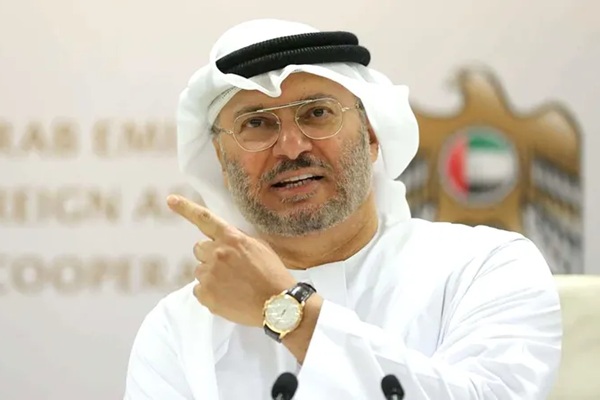
The Middle East cannot remain trapped in a cycle of escalation without either a return to stability or a credible political settlement, UAE Presidential Diplomatic Adviser Dr Anwar Gargash has warned, calling for “realistic and sustainable” solutions to the region’s prolonged crisis.
His comments came as tensions rose again on Monday, with the UAE Ministry of Defence saying its Air Force had responded to a UAV detected over the country’s territorial waters approaching from Iran.
“A state of neither war nor peace cannot be a sustainable solution,” Gargash wrote on X. He called for an immediate move beyond escalation, the restoration of normal navigation through the Strait of Hormuz and a political approach that addresses both the economic and security dimensions of the crisis.
Gargash also said that targeting Gulf states and Jordan had “proven to be a failure”, arguing that such attacks had only deepened Iran’s isolation and weakened its strategic position.
The UAE Ministry of Defence said the Armed Forces remained on a high state of readiness, while air-defence systems continued to monitor and protect the country’s airspace. The ministry separately denied reports that Al Menhad Air Base had been targeted by missiles.
The latest escalation followed US strikes on Iranian missile launchers on Larak Island in the Strait of Hormuz on Sunday, followed by Iranian ballistic-missile attacks on US forces in Jordan.
Beyond escalation
Gargash’s remarks reinforce a position he has articulated in recent days: the way out of the crisis cannot be through further attacks on Gulf states, but through engagement with them and the creation of conditions for a sustainable political settlement.
His call comes as the conflict enters a prolonged phase in which military pressure and diplomatic efforts continue to run in parallel. UAE strategic and diplomatic experts have similarly warned that the region cannot indefinitely remain in a grey zone between open conflict and fragile diplomacy.
Dr Mohammed Ibrahim Al Dhaheri, Deputy Director-General of the Anwar Gargash Diplomatic Academy, said dialogue could not be treated as an end in itself.
“Dialogue serves a purpose only when it produces measurable compliance,” he said, arguing that future security arrangements would require enforceable commitments and independent verification.
Freedom of navigation through the Strait of Hormuz, he added, must remain protected from political pressure. The waterway is a critical artery for global trade and energy flows, making its security a central element of any future regional settlement.
A harder diplomatic equation
Fatmah Alzeyoudi, a researcher in Iranian and Middle East affairs at the Emirates Centre for Strategic Studies and Research, said Iran’s strategy of targeting the UAE had failed to achieve its intended objectives.
She argued that the attacks had demonstrated the UAE’s growing defensive capabilities while reinforcing its determination to maintain a disciplined approach to regional security.
The message from Abu Dhabi is therefore not a rejection of diplomacy, but a demand for diplomacy backed by credible guarantees.
“Diplomatic dialogue will continue as a regional necessity,” Alzeyoudi said. “However, dialogue alone is no longer sufficient.”
For the UAE, the challenge now is to move the region away from a cycle in which military escalation repeatedly closes the door to diplomacy and towards a framework in which political engagement produces tangible, verifiable results.