



















What is known about the outcome of the trilateral talks in Abu Dhabi
Back To Main Page: Diplomatic News, UAE News
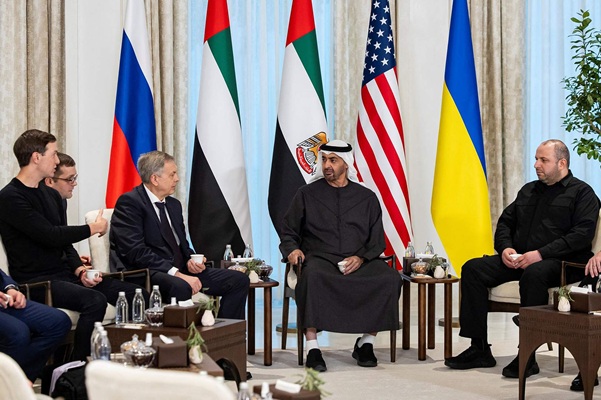
A new round of negotiations involving delegations from Russia, Ukraine, and the United States took place in the United Arab Emirates on January 23–24. Representatives of the three countries discussed possible ways to resolve the Ukraine crisis. Here is what is known so far about the results of the meeting and its prospects.
The meetings were held behind closed doors at the Qasr Al Shati residence. The compound is closed to visitors and is used exclusively for high-level meetings, including those between UAE President Sheikh Mohammed bin Zayed Al Nahyan and foreign heads of state.
The Russian delegation was led by Igor Kostyukov, head of the Main Directorate of the General Staff of the Russian Armed Forces. The Ukrainian delegation was headed by Rustem Umerov, Secretary of Ukraine’s National Security and Defense Council.
The U.S. delegation included presidential special envoy Steve Witkoff, Donald Trump’s son-in-law Jared Kushner, Federal Procurement Service Commissioner Josh Gruenbaum, and NATO Supreme Allied Commander Europe Alexus Grynkewich.
Issues Discussed in Abu Dhabi
The agenda included territorial issues, the establishment of buffer zones, mechanisms to monitor compliance with a ceasefire, and the management of the Zaporizhzhia Nuclear Power Plant.
A source cited by the Financial Times said that the Ukrainian and U.S. delegations pushed for an “energy truce,” under which the Russian military would halt strikes on Ukraine’s energy infrastructure, while Ukraine’s armed forces would stop attacking cargo vessels transporting Russian oil and oil refineries.
What Was Agreed at the Abu Dhabi Talks
Little is known about the concrete outcomes of the two-day negotiations. Public comments from the parties have been limited to general assessments.
Russian Deputy Foreign Minister Sergei Ryabkov said that the Russian delegation in Abu Dhabi was defending the basic understandings reached in the United States following the Alaska summit. In an interview with TASS, Ryabkov stressed that “delving into the details of what is happening would be counterproductive.”
Steve Witkoff, Donald Trump’s special envoy, wrote on social media that the talks ended on a “constructive note” and would resume next week.
Reuters, citing an anonymous official, reported that the next round of negotiations is scheduled for February 1.
According to anonymous sources quoted by Axios who are senior White House officials, the parties discussed the conditions for a possible settlement. The dialogue was described as constructive, with participants showing mutual respect. One source said that on January 24, after the joint sessions, members of all three delegations went to lunch together and “almost looked like friends.”
At the same time, Reuters reported that the sides failed to reach agreement on territorial issues. Moscow continues to demand the full withdrawal of Ukrainian forces from the territories of Donbas, while Kyiv rejects these demands.
Ukrainian President Volodymyr Zelensky said the talks confirmed that there are many contentious issues between Kyiv and Moscow. He added that Ukraine intends to maintain its previously stated position on territorial matters and will not relinquish its regions, RBC reported, citing RBC Ukraine.
Axios also reported that a bilateral summit involving Russian President Vladimir Putin and Ukrainian President Volodymyr Zelensky could take place in the near future. White House officials told the outlet that such talks are not far off. “We think we’re not far from that. If we continue on the current path, we’ll get there,” TASS quoted an Axios source as saying.
Expert Assessments and Prospects
Nikolai Silaev, a senior research fellow at MGIMO’s Institute of International Studies, told Vedomosti that the main result of the talks was the parties’ agreement to continue negotiations. He said the delegations discussed contentious issues in Abu Dhabi, including a ceasefire along the line of contact. According to Silaev, this would require clarification of timelines and parameters for the withdrawal of Ukrainian forces from certain areas.
Silaev believes that security guarantees for Russia and Ukraine, as well as humanitarian and economic issues, were not discussed in Abu Dhabi. He also expressed skepticism that a Putin–Zelensky meeting would take place soon, arguing that such talks require lengthy and careful preparation.
Andrei Kortunov, an expert with the Valdai International Discussion Club, suggested that the trilateral contacts in the UAE focused mainly on technical issues, such as the conditions for implementing a ceasefire and the functioning of buffer zones. He told Vedomosti that other aspects of a potential truce would likely be discussed at a different level.
“Unlike the Ukrainian leadership, Moscow is so far insisting on discussing military-technical issues. At the same time, the diversified composition of the Ukrainian delegation points to broader expectations on Kyiv’s part,” Kortunov said.
He added that Kyiv and Moscow remain far from reaching agreements on territorial issues. According to the political analyst, a new meeting is expected soon, and if the current pace of talks is maintained, this could signal a renewed push in the peace process. However, he emphasized that the positions of Ukraine and Russia still differ significantly.