


















Artemis II Crew witnesses meteorite impacts on the Moon in real time
Back To Main Page: Discoveries, UAE News
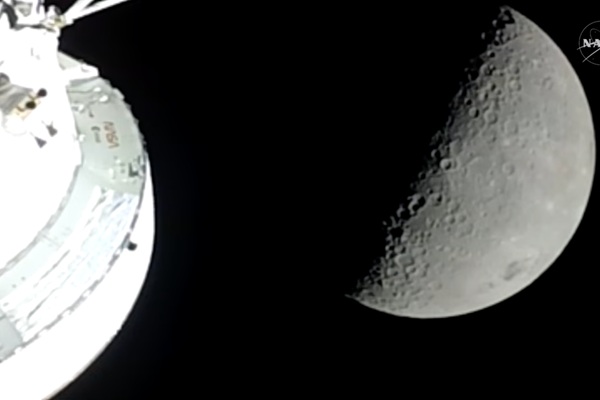
In a remarkable moment for space exploration, astronauts aboard Artemis II observed meteorites striking the surface of the Moon in real time, offering a rare and vivid glimpse into the dynamic environment of Earth’s closest neighbor.
The historic observation took place as the crew traveled beyond low Earth orbit, retracing a path not flown by humans since the era of Apollo program. Unlike Earth, the Moon lacks a protective atmosphere, meaning even small space debris can impact its surface at high speed, producing sudden flashes of light visible from orbit.
According to NASA, the astronauts witnessed multiple brief but bright bursts across the lunar terrain — the direct result of meteoroids colliding with the Moon’s surface. These impacts, while common, are rarely seen from such proximity and in real time by human observers.
The phenomenon highlights a fundamental difference between Earth and its satellite. On Earth, most meteoroids burn up in the atmosphere, creating what we perceive as shooting stars. On the Moon, however, there is no atmospheric shield, so impacts occur directly, leaving behind small craters and releasing visible energy upon collision.
For scientists, such observations are more than just visually striking — they provide valuable data. Studying these impacts helps researchers better understand the frequency and scale of meteoroid activity in near-Earth space, as well as the long-term evolution of the lunar surface. The insights could also prove critical for future lunar missions, particularly in assessing potential risks to infrastructure and human presence on the Moon.
The Artemis II mission represents a major step forward in NASA’s broader ambitions to return humans to the Moon and eventually establish a sustainable presence. As the first crewed mission in the Artemis program, it is designed to test systems and operations in deep space, paving the way for future landings.
Beyond its technical objectives, moments like these underscore the unique perspective offered by human spaceflight. Watching meteorites strike the Moon in real time is not only a scientific opportunity but also a powerful reminder that space is far from static — it is an active, ever-changing environment.
As humanity prepares for a new era of lunar exploration, the Artemis II crew’s observations serve as both a scientific milestone and a compelling preview of what future explorers may witness firsthand on and around the Moon.