





















Van Cleef & Arpels – ALHAMBRA – A new light on an iconic motif
Back To Main Page: Watches and jewelry

In 1968, the Maison wrote the first chapter of the Alhambra collection. With the passing years, it became an icon of luck that embodied the spirit of Van Cleef & Arpels. Inspired by the four-leaf clover, its motif transcended the eras, constantly reinvented with new materials and functions. Ornamental stones, such as onyx and carnelian, organic materials like mother-of-pearl, as well as guilloché gold and Sèvres porcelain, renewed its timeless allure.
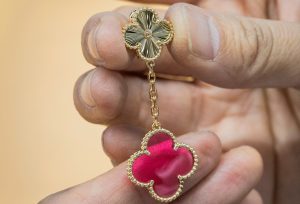
Today, the Maison unites this symbol with one of its treasured expertise: enamel. This precious material adorns a new jewelry set, composed of a long necklace, a necklace, a pendant, a bracelet and earrings. Highly prized throughout history, it has graced the creations of Van Cleef & Arpels since its origins in 1906.
The Alhambra collection palette is now enriched with a vibrant, intense and translucent pink enamel enlivened with tiny bubbles that imbue it with life and depth. The result of years of research and development in the Maison’s workshops, this material also illustrates its commitment to rare métiers d’art.

“With these Alhambra creations in enamel, Van Cleef & Arpels opens a new chapter in the history of its iconic collection, symbol of luck. Thanks to our workshops’ expertise and capacity for innovation, enamel brings an original esthetic and shade to the Alhambra universe, which has continuously reinvented itself over the decades. This traditional jewelry material delivers effects of color, light and transparency, patiently fine-tuned to enhance the pieces, which we are delighted to present to you today.”
Catherine Renier, President and CEO of Van Cleef & Arpels

The Alhambra collection, Van Cleef & Arpels’ icon of luck
A story unfolding since 1968
“To be lucky, you have to believe in luck,” Jacques Arpels, Estelle Arpels’ nephew, liked to say. A core value for the Maison, luck has often guided its footsteps and inspired some of its most iconic creations. Four-leaf clovers appeared as early as 1906 in the Van Cleef & Arpels Archives. Over the years, they were joined by wooden talismans, charms and ladybugs.
In 1968, the Maison created the first Alhambra long necklace, inspired by the shape of the four-leaf clover. Its original motif, with pure and harmonious lines, established itself as Van Cleef & Arpels’ icon of luck. The creation was composed of 20 motifs in textured yellow gold, trimmed with a double beaded contour. With its stylized esthetic, fluidity and everyday wear, this piece complemented silhouettes and embraced the aspirations of the era. An instant success, it marked the start of a distinctive collection that would continue to renew itself over time.
Decade after decade, it welcomed a vast palette of materials and shades that enriched its timeless elegance. Yellow, rose or white gold, polished, textured or guilloché, joined ornamental stones, organic materials, diamonds and even Sèvres porcelain. Colors and textures harmonized with each creation, reinventing the Alhambra universe.
Enamel, when color meets radiance
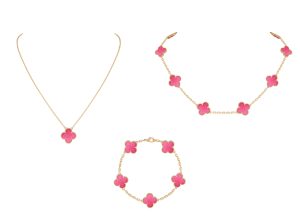
Continuing over 50 years of creativity, the Maison now presents five new Vintage Alhambra and Magic Alhambra creations in translucent enamel. Within their gold-beaded contours, the motifs catch the eye in an original pink tone, chosen by Van Cleef & Arpels to perpetuate the collection’s polychrome identity.
Specially developed to bring the Creation Studio’s designs to life, this intense hue was obtained using a technique inspired by the “gold-ruby” process. In this 17th-century method, the color is generated not by pigments, but rather the presence of fine gold particles in the composition of the material. Particularly complex to achieve, this ideal shade requires particles that are just the right size, shape and concentration. Several years of research and development in Van Cleef & Arpels’ enamel workshops were needed to define and perfect the procedure for the Alhambra motifs.
Combined with yellow gold or guilloché yellow gold, the enamel of the Alhambra creations reveals a translucent material, strewn with tiny bubbles, which imbue each motif with life, depth and singularity. This material also stands out with its light-reflecting capacity—slightly superior to that of emerald—resulting in a characteristic sparkle. Each motif features a curved surface, designed to intensify its shine and ensure shimmering reflections
At the heart of the Maison’s know-how
The expertise of Van Cleef & Arpels’ workshops
Year after year, the Maison’s commitment to métiers d’art has transformed into true in-house expertise. To bring the creative intentions of projects to life, Van Cleef & Arpels’ enamel workshop now masters over 15 enameling techniques. These include enamel miniature painting, grisaille enamel, plique-à-jour enamel, and enamel decal. Reflecting the Maison’s commitment to preserving know-how, an in-house enameling school (three-year program) supports artisans in their training.
Beyond traditional methods, the Métiers d’Art division also works on perfecting techniques and inventing new ones, such as façonné enamel. This specific skill makes it possible to obtain a three-dimensional shape with remarkable effects of volume and transparency, as seen on the Lady Arpels Jour Enchanté watch and the Perlée Extraordinaire Fruits Enchantés pieces.
Now, with enamel in Alhambra creations, the Maison’s expertise and capacity for innovation have joined forces to bring this new chapter’s intentions to life.
Creations backed by jewelry-making know-how
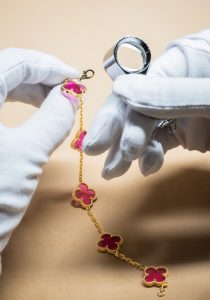
Upholding the Maison’s tradition of excellence, the Alhambra collection embodies its jewelry-making expertise and fine eye for detail. From the production of enamel motifs to the steps carried out in Van Cleef & Arpels’ workshops—jewelry work, setting and polishing, to name a few—an array of skills come together to give form to the creations.
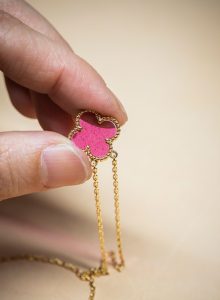
Particular precision is called for when it comes to adjusting the curved enamel motif in its setting. This precious contour is distinguished by its double row of golden beads, a distinctive Van Cleef & Arpels style signature. Its even curves are the result of painstaking jewelry-making and polishing work. Playing with light, the golden spheres enhance the reflections of the enamel, which is strewn with fine bubbles.
During the setting process, the claws are delicately folded down to hold each symbol while remaining discreet. On the back, they are rounded into a ball shape to ensure a soft touch on the skin or clothing.
Each element adds to the beauty of the entire piece: the chain linking the motifs is faceted to accentuate its luster. At the nape, the clasp—decorated with the Maison’s monogram—completes the piece with a refined touch and signature.
Once complete, each creation is carefully inspected to guarantee a result that meets Van Cleef & Arpels’ high standards of quality.
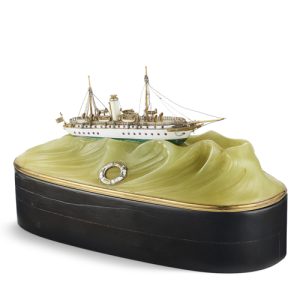
Enamel, a historic material prized by the Maison since 1906
Traditional decorative arts know-how...
Enamel appeared over 3,500 years ago in Greece, in the Mycenaean civilization. During the first millennium B.C., it spread throughout the Mediterranean region, before being used by other civilizations around the world, notably for royalty. Recognized from the start as a precious material in its own right, it met with great success, owing to its physical and aesthetic properties. Enamel was combined with gold and gemstones on objects, ornaments and jewelry in the most prestigious collections.
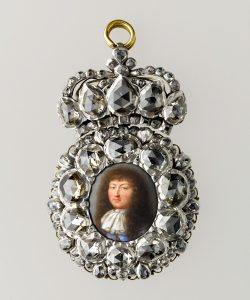
Illustrious European rulers ordered enameled jewels in their likeness to offer as diplomatic gifts or as tokens of affection. One example is a portrait box crafted around 1680 by grand enamel artist and painter Jean Petitot and goldsmith Le Tessier de Montarsy. It features an oval miniature of Louis XIV, sumptuously surrounded by diamonds. The back is also enameled with the royal cipher (interlacing double L) and scrolls.
In the late 18th century, enamel was also used for the miniature reproduction of remarkable landscapes on medallions and other jewelry. These enameled paintings were often brought back as souvenirs from trips taken during the Grand Tour. The different techniques allowed for a variety of striking effects: meticulous decorations, colors, and even shadow and light.
Louis XIV portrait box, circa 1680
Louvre Museum, Department of Objets d’Art of the Middle Ages, the Renaissance, and Modern Times
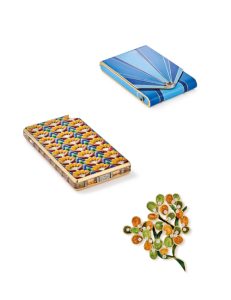
… rooted in the Maison’s history from the very start
Since its foundation in 1906, Van Cleef & Arpels showcased the qualities of enamel to adorn a wide array of creations: precious objects, boxes, chatelaine watches, timepieces and jewelry—clips, in particular. Benefiting from a vast color palette and different techniques, this material allowed the Maison to express all its creativity. Through the 1930s, geometric designs influenced by the Art Deco movement could be seen side by side with landscapes inspired by faraway cultures and figurative scenes, notably from the athletic world.
In the 1950s and 1960s, with its la boutique offer, which showcased everyday, easy to wear pieces, Van Cleef & Arpels gave life to endearing animal pieces, with certain details illustrated in enamel. This material also lent its hues to floral creations. Some bouquets had transparent petals, made possible with the plique-à-jour enamel technique.
Until the late 1980s, the Maison dreamed up realistic figurative pieces, often inspired by faraway lands. In them, enamel lent its wide color palette to a vibrant and joyful bestiary.
From its first Poetic Complications watch in 2006, named Lady Arpels Centenaire, Van Cleef & Arpels turned to enamel to infuse its dials with poetry. Year after year, different techniques made it possible to create decorations with remarkable depth, as seen in the Lady Arpels Pont des Amoureux timepiece. The Extraordinary Dials collection also illustrates the Maison’s ability to unite jewelry-making expertise and métiers d’art to create scenes full of details and depth.
About Van Cleef & Arpels
Van Cleef & Arpels was born in Paris, at 22 Place Vendôme, in 1906. Its founding resulted from the 1895 marriage of Alfred Van Cleef and Esther ( known as Estelle) Arpels, both from families of jewelry merchants. The Maison’s sources of inspiration—including love, nature, couture and dance— open the gate to an enchanting universe.
Guided by excellence, Van Cleef & Arpels is distinguished for its gemstones selected according to the most stringent criteria, its expert savoir-faire and its taste for innovation, expressed throughout its High Jewelry, Jewelry and Watchmaking collections. Today, its style, embodied in numerous signatures such as the Mystery Set technique, the Minaudière, the Zip necklace and the Alhambra motif, continues to blend inventiveness and poetry.